Planning an Event: The Scientifically Backed Checklist for Corporate Events

Start with the impact, not the program
Many planning processes begin with a familiar question:
- What are we going to do?
- The better question is:
- What should the event achieve?
- Should knowledge be shared?
- Should people get to know each other better?
- Does a decision need to be prepared?
- Is it about motivation, recognition, customer loyalty, or brand positioning?
Formulate the main goal in a single sentence: After the event, our guests should… The sentence could end, for example, like this:
… understand the new strategy.
… have made three relevant connections.
… support a joint decision.
… feel like part of the company.
… not only know the new product, but experience it.
Only then are the format, venue, technology, catering, and staging defined. A gala dinner may be the right choice for showing appreciation, but it’s the wrong format for a controversial strategy discussion. A large stage draws attention but doesn’t automatically foster dialogue. A clear objective also helps keep the budget in check. Every program item must be able to demonstrate how it contributes to the desired outcome. If it cannot, it is merely decoration or a matter of habit.
Translate the target audience into concrete planning criteria
The target audience is more than just a guest count. Two hundred executives may require a different venue layout than two hundred new employees. International guests have different requirements regarding language, travel, and orientation than a regional team. An audience that already knows each other reacts differently than guests meeting for the first time. Therefore, clarify the following early on:
Prior knowledge: What do the guests already know about the topic?
Relationships: Do they know each other, and are there hierarchies or conflicts of interest?
Motivation: Are they attending voluntarily, out of professional obligation, or with specific expectations?
Language: Which content requires translation, subtitles, or multilingual materials?
Mobility: How will the guests travel to the event, and what support will they need on site?
Accessibility: What physical, sensory, or organizational barriers need to be taken into account?
Catering: What dietary preferences, allergies, and cultural requirements are relevant?
These answers do not result in an abstract target audience profile, but rather a list of specific planning decisions.
Plan the Entire Guest Journey
The event does not begin with the welcome on stage. It begins with the first invitation. The guest journey encompasses all touchpoints: invitation, registration, travel to the venue, entrance, orientation, accreditation, coat check, reception, program, breaks, catering, personal interactions, closing, departure, and follow-up communication. Walk through this journey consistently from a guest’s perspective.
- Where do they have to wait?
- Where is information missing?
- Where do they not know where to go?
- Where do lines form?
- Where might they feel excluded?
- Where do they experience their first positive surprise?
Especially at larger events, many problems don’t arise during the main program, but during transitions. Great content loses its impact if the accreditation process is slow, the coat check can’t be found, or the entire break is needed just to change rooms. Professional event organization makes complexity invisible to the guest.
Create a highlight and a deliberate ending
People don’t store experiences like a seamless video recording. A meta-analysis of the so-called peak-end effect shows that the retrospective evaluation of an experience is particularly strongly influenced by the most intense moment and by the ending. In the studies examined, this correlation was strong. In comparison, the duration of the experience had virtually no influence on the final evaluation. This does not mean that the rest of the event is unimportant. It means that memory works selectively.
Therefore, consciously define:
The content highlight: the insight, decision, or message you want to leave a lasting impression.
The emotional highlight: the moment when a sense of community, pride, surprise, or enthusiasm arises.
The ending: the final impression guests take with them as they leave the room.
A highlight doesn’t have to be loud. It can be a product unveiling, a personal story, a collective decision, an unexpected performance, or a quiet moment with great significance. The conclusion is just as crucial. A strong narrative should not end with organizational announcements, an overly long acknowledgment, or visible cleanup. The final moment needs a clear message, a powerful image, or a concrete next step. The last impression is not just an afterthought of the program.
Switch between listening and thinking along
Presentations convey information. However, they do not guarantee that this information will be processed. A widely cited meta-analysis examined 225 studies from college courses in the natural sciences, technology, engineering, and mathematics. Active learning methods led to better learning outcomes compared to traditional lecture-style instruction. The study does not directly pertain to business events. However, it provides strong evidence that active engagement can be more effective than passive listening.
For event planning, this means:
- Break up long blocks of information with targeted processing.
- Don’t just let guests ask questions—have them apply the content.
- Use discussions, case studies, polls, and workshops only if they produce a tangible outcome.
- A live vote does not automatically constitute interaction. It only becomes relevant if the result influences the course of the event.
A workshop requires at least three elements:
- A precise question.
- A clearly defined outcome.
- A person who will follow up on the outcome.
A workshop without an outcome is merely a conversation with facilitation cards.
Treat breaks as part of the program
Breaks are not wasted event time. They allow for processing, movement, informal conversations, and a shift in focus. In a laboratory experiment involving 84 participants, brief, infrequent task changes prevented the usual decline in attention typically observed during a prolonged, monotonous task. The study does not reflect a complete event day. However, it shows that a deliberate change in activity can support sustained attention. For an event, this does not mean that every session must end according to a rigid time limit. The key is the rhythm. A challenging presentation should be followed by a different type of activity. An intensive workshop session can transition into an open break. An emotionally charged program item needs space before the next message follows.
However, a break only works if it can actually be used as a break. A ten-minute break that’s entirely consumed by trips to the restroom, waiting in lines, and moving to another room hardly fulfills this function. Therefore, plan not only the duration of the break but also its capacity, routes, and purpose.
Choose the event venue based on impact and flow
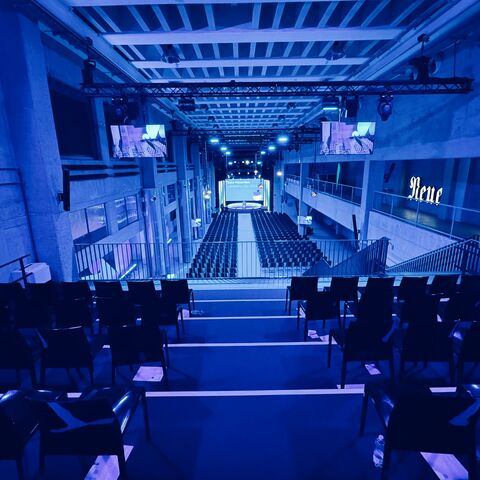
An event venue is not just an interchangeable backdrop. It is the operating system of the event. The crucial question is not just: How many people can it accommodate? But rather: What must these people be able to do during the course of the event? When touring an event venue in Zurich, be sure to check at least the following points:
Travel and Orientation: Can guests find the entrance and reach the venue using the intended modes of transportation?
Reception: Is there enough space for registration, a coat check, and initial mingling?
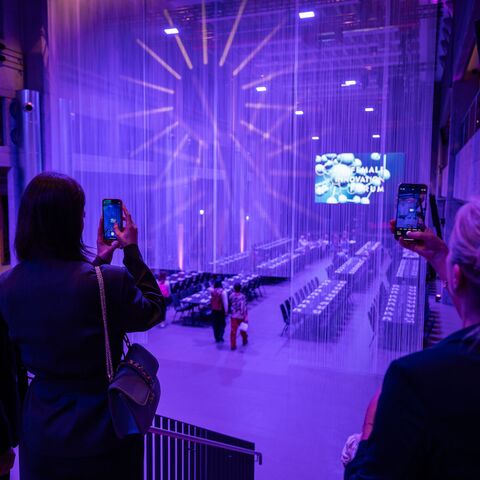
Ambience: Does the atmosphere align with the company’s message and identity?
Line of sight: Can all guests see the stage, presentations, and key program highlights?
Acoustics: Is speech intelligible in all areas?
Flow: Do entry, breaks, catering, and room changes proceed smoothly without bottlenecks?
Concurrent Activities: Are suitable rooms available for workshops, breakout sessions, quiet spaces, or production?
Logistics: Are delivery, setup, backstage areas, and technical operations feasible?
Weather: Is there a realistic alternative for outdoor areas?
Integration: Can the venue, technology, catering, and furnishings work together effectively?
A space may appear large enough on the spec sheet but still not be suitable for the event. The right space isn’t determined by maximum capacity, but by seating, stage design, technology, catering, movement zones, and the desired atmosphere.
Treat acoustics as part of the content
A perfect presentation is of little use if half the audience has to strain to hear. Research on speech perception shows that speech in noisy environments requires additional effort. Reverberation and poor room acoustics can also increase cognitive load. Age, hearing ability, and seating location further influence how well content is understood. Acoustics is therefore not just a technical task. It determines whether the content gets across at all. Don’t conduct the sound check exclusively in front of the stage. Test speech from the sides, under balconies, in the back, and at every location where guests will be sitting or standing.
Also plan for:
- Microphones for audience questions.
- Clear responsibilities for sound and presentations.
- Separation of the stage program from catering noise.
- Subtitles or written key messages, if this is helpful for the audience.
- A technical backup for critical components.
- Good technology shouldn’t be noticeable. Bad technology is immediately obvious.
Use the Budget as a Decision-Making Tool
An event budget is not just a list of cost items. It highlights which elements are essential to the event’s success. There is no one-size-fits-all percentage breakdown. A general meeting has different priorities than a product launch or an employee event. It makes sense to divide the budget into three categories:
Basics
Everything that must function reliably. Depending on the event, this includes the venue, staff, technology, security, logistics, basic furnishings, and necessary infrastructure.
Impact
Everything that specifically enhances the desired experience. This may include content, moderation, staging, catering, entertainment, room design, or interactive formats.
Reserve
Everything that can respond to changes, risks, and additional requirements. The reserve should not be viewed as an arbitrarily available creative budget. It ensures the ability to act when guest numbers, technology, weather, the program, or production requirements need to be adjusted.
For every major expense, ask yourself:
- What goal does it support?
- How does it change the guest experience?
- What additional costs does it trigger?
- What happens if we do without it?
This turns the budget into a strategic filter rather than an after-the-fact checklist.
Make catering part of the concept
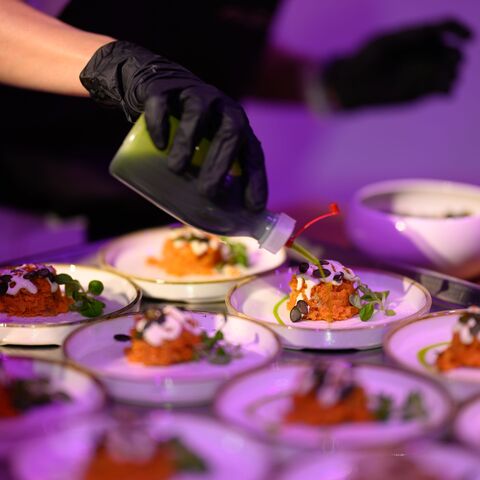
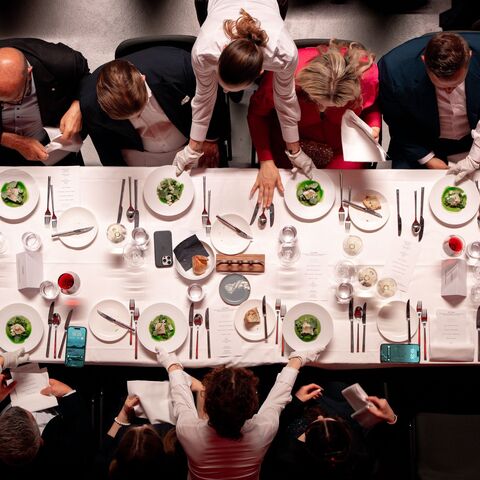
Catering is not just a break between two program items. It influences energy levels, interactions, scheduling, appreciation, and sustainability. A sit-down dinner creates a different conversational dynamic than live cooking or a market-style concept. A standing lunch encourages movement and changing interactions, but may be less suitable for longer conversations or certain groups of guests. The service format must therefore align with the event’s objective.
Menu design also has a significant environmental impact. A study published in Nature Food study published in Nature Food combined dietary data from 55,504 people with 570 life cycle assessments from more than 38,000 farms in 119 countries. In the group studied, the environmental impact—as measured by various metrics—increased with the proportion of animal products. In the model, the greenhouse gas emissions and land use associated with a vegan diet were about one-quarter of those of a diet high in meat. The study examined dietary patterns, not event menus. Nevertheless, it points to a clear direction for menu planning.
In practice, this means:
- Don’t relegate plant-based dishes to the margins as a special option. Develop them as a natural and culinarily compelling part of the menu.
- Gather dietary requirements at the time of registration.
- Plan portion sizes, additional production, and service methods together.
- Avoid long lines by setting up appropriate serving stations and streamlining processes.
- Use catering as a place for people to gather, not just for food.
- Even the best menu loses its appeal if guests have to spend a significant portion of their break waiting in line for it.
Focus sustainability efforts on the key levers
Sustainable event planning is not about isolated symbolic gestures. What matters most are the areas with the greatest actual impact. Mobility and event format can be particularly relevant here. A life cycle assessment compared in-person formats with virtual and hybrid alternatives using a conference as an example. In this specific case, the virtual format reduced the calculated CO₂ footprint by 94 percent and energy consumption by 90 percent. Hybrid locations chosen based on geographical considerations were able to reduce these figures by about two-thirds while simultaneously enabling a significant level of in-person participation. These figures are from a case study and are not universally applicable to every event. However, they demonstrate how significantly travel and format can influence the outcome.
When planning, therefore, start with the structural decisions:
Location: Is the venue easily accessible by public transportation?
Invitation: Are travel options communicated early and clearly?
Participation format: Do all attendees need to travel in person, or would digital participation be appropriate for certain groups?
Catering: What percentage of the menu consists of plant-based dishes?
Production: Which materials can be reused, rented, or repurposed for future events?
Waste: How much waste is generated, and how is it sorted or prevented?
Supply chain: Can services and transportation be bundled?
Sustainability is credible when it is visible in the planning and not merely claimed in communications.
Don’t create a Plan B without a trigger and assigned responsibility
A Plan B is worthless if no one knows when it will be activated. For critical risks, create a simple overview with six pieces of information:
Risk: What could happen?
Early warning signs: How do we recognize the development?
Decision point: By when must action be taken?
Responsibility: Who makes the decision?
Action: What specifically will be done?
Communication: Who needs to be informed, and how?
Typical risk areas include technology, weather, speakers, suppliers, number of guests, access, transportation, medical incidents, and schedule changes. The necessary safety requirements depend on the venue, event type, setup, and relevant authorities. They must therefore be coordinated with the venue and the responsible specialist partners. Internal communication is at least as important. At JED Events, it is described as one of the most frequently underestimated aspects of event organization. It is crucial that all participants share the same goal and receive the right information at the right time. A good briefing, therefore, does not just explain what needs to be done; it also explains why it is being done.
Don’t Measure Success by the Applause
The question of success should not be asked only after the event. Measurement begins with the goal. If the aim is to impart knowledge, it must be assessed what was understood and retained. If decisions are to be made, the outcome, responsibility, and next steps must be documented. If the goal is to build relationships, it is important to determine whether valuable contacts were made and meaningful conversations took place. If the goal is to boost motivation, one should consider not only immediate satisfaction but also the long-term impact.
Possible metrics include:
Participation: Registrations, actual attendance, and use of individual formats.
Interaction: Questions, contributions, votes, and workshop results.
Outcome: Decisions, tasks, contacts, or qualified inquiries.
Perception: Relevance, clarity, atmosphere, and word-of-mouth recommendations.
Transfer: Actions that are actually implemented after the event.
A general satisfaction question is rarely sufficient. It shows whether people enjoyed the event, but it does not necessarily explain whether it achieved its strategic goal.
Instead, ask a few precise questions:
- What was most valuable to you?
- What specific insight will you apply?
- What would have made the event more relevant?
- This way, feedback becomes not just an evaluation, but a foundation for the next event.

Frequently Asked Questions About Event Planning
What should be included in an event planning checklist?
A comprehensive event planning checklist includes objectives, target audience, budget, date, venue, guest journey, program, flow, technology, catering, staff, sustainability, safety, communication, and performance measurement. It’s not just a matter of whether every area has been addressed; all decisions must be aligned with the same event objective.
How far in advance should you plan a corporate event?
There is no one-size-fits-all lead time. The larger, more complex, and more time-sensitive the event is, the earlier planning should begin. Highly sought-after dates, large-scale productions, external speakers, and custom structures all require a longer lead time. The first phase can begin as soon as the objective, approximate number of guests, time frame, and budget are known.
How do I find the right event venue?
The right event venue isn’t chosen based solely on capacity. Other relevant factors include accessibility, atmosphere, room layout, acoustics, sightlines, technical capabilities, catering, breakout rooms, logistics, guest flow, and potential weather alternatives. The venue must support the event’s flow and the desired impact.
How do I plan an event budget?
First, define the essential basics, then the elements relevant to the event’s impact, and finally a contingency fund. Consider follow-up costs with every decision. An additional stage, for example, may require extra equipment, staff, setup time, and safety measures.
How do you measure the success of a corporate event?
Measurement depends on the objective. Possible metrics include attendance, interaction, knowledge gained, decisions made, qualified leads, concrete follow-up actions, and guest feedback. Ideally, both immediate perceptions and subsequent implementation are taken into account.
Event planning that feels effortless for guests
A successful event appears effortless. Not because little planning went into it, but because the planning was precise.
At JED Events, historic industrial architecture, flexible spaces, culinary offerings, technology, and event expertise come together. The former NZZ printing plant provides the setting for a variety of event formats and combines key services under one roof. Are you planning a corporate event, a conference, a annual general meeting, a management meeting, or a gala in Zurich? Let’s work together to determine which setup best suits your goals, your guests, and your event concept.


