Blog · approx. 9 min read
The key points
›Most venue searches in Zurich fail on coordination, not on the shortlist: five venues, three caterers and a technical supplier mean thirteen email threads before anyone has quoted a price.
›Define guest numbers, seating and the event goal before you contact anyone. Those three inputs decide which spaces are even worth a proposal.
›A venue that hosts several spaces under one roof turns a multi-venue search into one request: you compare setups instead of suppliers.
›A serious proposal names the room rate, catering per person, technology and staffing separately. If a quote gives you one number, ask for the breakdown.
›At JED, one request covers eight event spaces from 20 to 840 guests including catering and event technology, and you get a proposal back within 24 hours.
Zurich has no shortage of event venues. It has a shortage of comparable offers. Anyone who has organised a company event here knows the pattern: you shortlist five locations, write five briefings, receive five quotes that are structured completely differently, and then start again with caterers and technical suppliers. The venue search is rarely lost on the venues themselves. It is lost in the coordination around them.
This guide walks through the criteria that actually decide whether a venue fits, and shows how to get from a vague idea to comparable proposals with as few requests as possible.
What goals should your event venue serve?
Before you look at a single floor plan, answer one question: what is this event supposed to achieve? A product launch that needs press coverage has different requirements than an internal kick-off or a staff Christmas party. The goal determines the format, the format determines the seating, and the seating determines which rooms are realistic at all.
›Representation and press: you need a venue with its own character and images that work. Neutral hotel ballrooms rarely deliver either.
›Working and content: you need daylight, breakout areas and technology that works without an external crew.
›Celebration and networking: you need standing capacity, catering zones and a room that still feels full at 11 pm.
Write these answers down in three sentences. They will become the core of every request you send, and they are the reason a venue can quote you something useful instead of a price list.
How big does the venue need to be for your guest count?
The single most common error in venue requests is a guest number without a seating plan. Two hundred people at a seated gala dinner need roughly three times the floor area of two hundred people at a standing reception. A room that is described as fitting 200 may fit 200 in one setup and 90 in another.
Ask for capacities per setup, not as a range. As an example, these are the figures for the event spaces at JED in Schlieren:
| Space |
Theatre |
Classroom |
Cabaret |
Gala (long tables) |
Gala (round) |
Standing |
| Event hall |
630 |
320 |
230 |
540 |
320 |
840 |
| Eve’s Kitchen |
99 |
60 |
– |
126 |
70 |
300 |
| Offset |
180 |
93 |
55 |
160 |
110 |
240 |
| Bridge |
130 |
87 |
60 |
– |
– |
240 |
| Taverne |
– |
– |
– |
20, up to 44 with extra tables |
– |
approx. 40 |
Meeting rooms are booked in combination with an event space: Hyperion and Sequoia hold 50 in theatre style each, the boardrooms between 8 and 16 people. The full details are on the individual room pages.
In short: a guest number alone is not a brief. Guest number plus seating plus catering format is.
What technology should an event venue provide?
Ask what is permanently installed and what has to be hired in. The difference frequently amounts to a five-figure sum. Permanently installed LED walls, lighting and sound mean no set-up crew, no transport, no rental invoice, and a shorter build day.
›Is lighting, sound and projection fixed in the room, or is it quoted separately?
›How much time is scheduled for set-up and take-down, and is that time charged?
›Is there a technician on site during the event, or do you supply one?
›What is the internet bandwidth, and does it hold if the event is streamed?
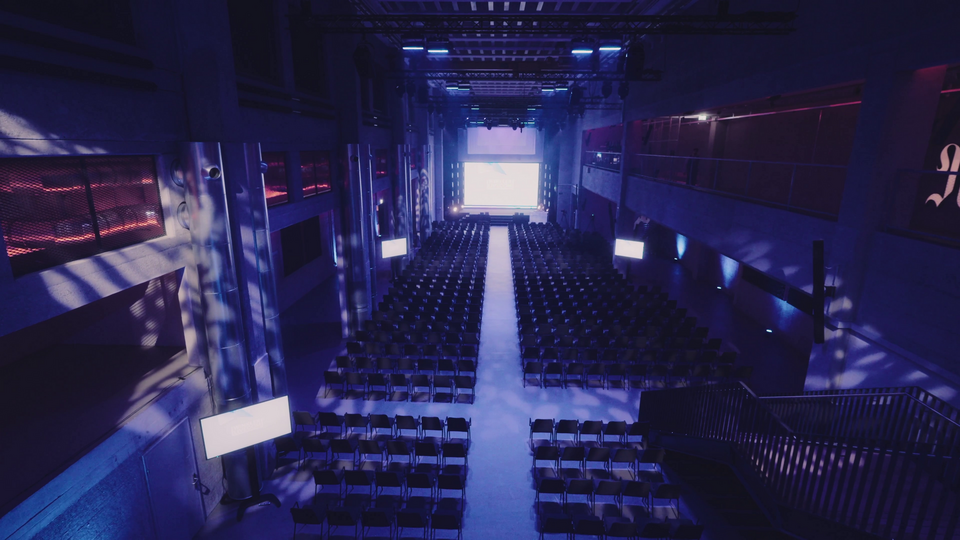
At JED, the event hall carries its LED wall, lighting and sound as part of the room. Details are on the event technology page.
How accessible does an event venue need to be?
Central does not automatically mean accessible. For company events, the question is how 300 people arrive within the same 30 minutes, and how they get home afterwards. A venue in the middle of the old town may look attractive on a map and still cost your guests 25 minutes of parking search.
›Public transport: how far is the nearest stop on foot, and how late does it run?
›Parking: how many spaces are actually available on site, and at what price?
›Deliveries: is there a loading area, and can a truck reach the room directly?
JED sits in Schlieren, eight minutes by S-Bahn from Zurich main station, with its own parking on site and direct motorway access, which also matters for guests travelling in from outside the canton.
Which ambience fits your event?
A room with its own history saves you a decorating budget. Industrial architecture, high ceilings and visible structure carry an event that a neutral function room needs draping, lighting and props to achieve. The JED site is the former printing hall of the Neue Zürcher Zeitung, and that is visible in the raw concrete, the gallery level and the ceiling height.
The practical test: ask for photographs of an event of your size in that room, not for the empty room. Empty rooms all look large.
How can you shorten the venue search?
This is where most of the effort in a venue search actually sits. A classic Zurich search for a 250-person company event means contacting five venues, three caterers and a technical supplier, then reconciling nine differently structured quotes. Most of the working time goes into comparison, not into decision-making.
There are two ways to reduce that.
›An agency or a venue-finding platform takes your brief and forwards it to several independent venues. You get several proposals from one request, but catering, technology and staffing are still quoted separately by each venue, and the platform is paid a commission that is priced into what you receive.
›A venue with several spaces under one roof answers your brief with several setups in a single proposal. You lose the comparison between different buildings, and you gain a like-for-like comparison of formats, with catering and technology already included in the same document.
The second route is the faster one when your event is not tied to a specific address. At JED, one request covers eight event spaces between 20 and 840 guests, in-house catering through Eve’s Kitchen and the installed event technology. If you do not yet know which room fits, you can tick “I don’t know yet” and receive proposals for the setups that match your guest number.
In practice, that turns thirteen email threads into one. The offer request form asks for the date, the guest number, the event type and the catering format, and the answer comes back within 24 hours.
In short: you do not need one request per venue. You need one request that is specific enough to be answered with a real number.
What does a serious venue proposal contain?
A proposal you cannot compare is not a proposal. Ask for the cost blocks to be listed separately, otherwise you will be comparing a room rate against an all-in package and drawing the wrong conclusion.
›Room: rate per day or per event, including which hours, and what an overrun costs.
›Catering: per person, by format, and what a drinks flat rate covers.
›Technology: what is included in the room, what is hired in.
›Staffing: service, technicians, security, cloakroom.
›Set-up and take-down: hours, and whether they are chargeable.
Then ask the question that decides the budget: what is not in this quote? Cleaning, waste disposal, SUISA fees, and overtime after midnight are the usual candidates.
How reliable are reviews when choosing a venue?
Reviews from private guests say little about how a venue handles a 400-person corporate event. Ask instead for two references from events comparable to yours in size and format, and call them. The questions worth asking are not about the room, they are about what happened when something went wrong.
Zurich’s event landscape at a glance
Zurich covers the full range, from hotel ballrooms and converted industrial halls to museums and lake-side venues. For company events, the practical field narrows quickly: you need a room that fits the guest number in the right seating, technology that does not have to be trucked in, catering that can serve everyone in the same window, and an address your guests can reach. Most searches end at three or four realistic candidates.
Frequently asked questions
Can I send one request for multiple venues in Zurich?
Yes, in two ways. Venue-finding platforms and event agencies forward one brief to several independent venues. Alternatively, a venue that operates several spaces answers your brief with several setups in one document. At JED, a single offer request covers eight event spaces from 20 to 840 guests, plus catering and event technology.
How quickly do you get venue proposals in Zurich?
That depends on how specific the request is. A request with a date, a guest number, a seating format and a catering format can be quoted directly. A request without those triggers a round of questions first and typically costs two to three additional days. JED responds within 24 hours.
What should an event venue proposal include?
The room rate with the hours it covers, catering per person by format, event technology split into what is installed and what is hired in, staffing, and set-up and take-down times with any charges. A single total figure without that breakdown cannot be compared against another venue.
How do I request a quote for an event venue in Switzerland?
Most venues use an online request form. Have the date and at least one alternative date ready, the number of guests, the type of event, the catering format and a rough budget. The JED offer request form asks for exactly those, and the desired rooms field can be left as “I don’t know yet”.
Do I need separate requests for catering and event technology?
Not at a venue with in-house services. At JED, catering runs through Eve’s Kitchen in the same building and the event technology is installed in the rooms, so both are quoted in the same proposal as the room. At venues without in-house services, plan for separate requests and separate contracts.
How many people fit into the JED event spaces?
Between 20 and 840, depending on the space and the seating. The event hall holds 630 in theatre style and 840 standing, Eve’s Kitchen 300 standing, Offset 160 at long tables, Bridge 130 in theatre style and the Taverne 20 at the large table for a seated dinner, up to 44 with extra tables. The table above lists the figures per setup, and the room pages carry the seating plans.
Once your goal, guest number and format are defined, the search itself is quick. If you would like to see what your event looks like in a concrete room with a concrete number, send us a non-binding request and you will have a proposal within 24 hours.