Heat, Heavy Rain, Fire Bans: How to Plan Events That Still Work
Blog · Approx. 11 min. read time
Key Points at a Glance
›Weather affects not only outdoor spaces, but also safety, technology, the food service industry, mobility, and communication.
›Determine in advance who monitors which signals, when decisions are made, and which alternative is triggered.
›Plan the contingency scenario on an equal footing with the preferred concept —not as a visible Plan B.
›Choose a venue where guests, catering, and technical equipment can be easily relocated to a reliable indoor alternative without having to travel long distances.
Content
01Weather Is No Longer a Marginal Issue02Start with the event’s risk profile03Work with a Trigger Matrix04Don’t just plan for a replacement space—plan for a replacement feeling05Make the entire guest journey weatherproof06The restaurant industry must adapt to changing weather conditions07Incorporate technology early and make dependencies visible08Clear Decisions Are More Important Than Perfect Forecasts09The location determines the quality of the transition10Ten Questions Before Release11Conclusion: A robust plan feels effortlessWeather is no longer a side issue
When planning a summer festival, the first thing that often comes to mind when planning for the weather is rain. In practice, rain is just one of several scenarios. Heat affects how long people stay, beverage demand, and the strain on guests and staff. Wind affects tents, umbrellas, stages, banners, and decorations. Thunderstorms may necessitate an evacuation or relocation. Dry conditions can restrict the use of fire, pyrotechnics, and certain barbecue setups. Heavy rain, in turn, affects not only the program but also access roads, ground surfaces, power lines, and coat check areas.
That’s why weather shouldn’t be left until the end of the production meeting. It belongs in the concept phase, alongside the event’s purpose, target audience, dramaturgy, technology, and catering. Anyone who waits until just a few hours before doors open to consider an alternative usually has to make several decisions at once. Those who plan for contingencies early on simply set a prepared sequence in motion.
Start with the event’s risk profile
Not every event needs the same weather plan. A cocktail reception on a terrace has different dependencies than a summer festival with a tent village, a performance stage, and multiple food stations. A robust risk profile therefore doesn’t start with a general checklist, but with five specific questions:
›Which program elements must remain outdoors, and which can be moved indoors without compromising quality?
›Which structures are sensitive to wind, water, heat, or softened soil?
›What permits or cantonal and municipal regulations could have an immediate impact on open fires, fireworks, noise, or land use?
›Which guests require special assistance in hot weather, when walking long distances, or in the event of a last-minute room change?
›Which suppliers, technical partners, and decision-makers must be reachable for a variant to actually be implemented?
These answers do not result in a weather forecast. Instead, they create a map of dependencies. It shows where a single event can affect multiple trades simultaneously. That’s exactly where prepared solutions are needed.
Work with a Trigger Matrix
A Plan B is too vague if no one knows when it applies. A trigger matrix is better. It links an observable signal to a decision point, a responsible person, and a prepared response. Threshold values must not be arbitrarily determined. They must be established jointly with the location, authorities, safety officers, and technical partners.
| Risk | Test Signal | Decision | Prepared Response |
|---|---|---|---|
| Heat | Official Warning Status, Forecast, Local Conditions | Set Deadline and Assign Responsible Person | Shade, water, adjusted schedules, shorter routes, additional breaks |
| Wind | Specifications from technical partners and on-site measurements | Before setup and again before admission | Secure, reduce, or block off structures; reschedule the program |
| Thunderstorms | Official Warning and Defined Lead Time | Before Admission and Ongoing | Seat changes, evacuation route, program interruptions, guest information |
| Heavy Rain | Forecast, Precipitation, Ground Conditions, and Access | Before Logistics Start and Before Entry | Canopy, floor protection, alternative routes, coat check, indoor option |
| No Open Flames | Cantonal and Municipal Status Updates | Before Purchasing, Setup, and Show Approval | Gas or electric instead of an open flame, alternative finale, adjusted decorations |
Important: The table is a planning framework. Specific threshold values and regulatory requirements must be confirmed for the respective location and occasion.
Don’t just plan for an alternative venue—plan for an alternative atmosphere
Many bad-weather alternatives fail not because of logistics, but because of the atmosphere. Outside, an atmospheric sunset was planned; inside, there are suddenly rows of chairs and task lighting. On paper, the event is saved. To the guests, however, it still feels like a second-best option.
The better question, therefore, isn’t: Where do we move people? It is: What function does the original program item serve? Fireworks create a shared finale. A terrace creates a sense of space and informal interaction. A food market generates movement and discovery. Once this function is clear, it can be staged differently .
›The joint finale can be created using lighting, projections, music, a stage reveal, or a choreographed indoor show.
›A sense of spaciousness can be achieved through open spatial axes, high ceilings, generous furnishings, and a carefully designed lighting atmosphere.
›Movement and discovery can be maintained through modular food stations, rotating program activities, or themed zones.
The example from Neuenegg illustrates this logic particularly clearly. The classic form wasn’t simply eliminated. Its emotional purpose was reimagined using water, light, and music.
Make the entire guest journey weatherproof
The weather plan doesn’t start on stage. It starts with the journey to the venue. Guests often experience wait times, distances, navigation, and comfort more intensely than the technical complexity behind the scenes. That’s why every phase should be reviewed:
›Arrival and Reception: Are there designated waiting areas, clear signage, and sufficient staff in the event of a last-minute room change?
›Stay: Are there sufficient shade, seating, water, a coat check, and accessible paths in the alternative option as well?
›Program: Can start times, breaks, or individual program items be adjusted without losing the overall message?
›Departure: Will exits, taxi zones, shuttles, and public transportation even during heavy rain or an early end?
In hot weather, free drinking water isn’t just a decorative extra—it’s a visible sign of good hospitality. That’s why the Swiss National Day celebration on Bern’s Bundesplatz included a drinking water station and a water feature as part of the event.
Catering must adapt to changing weather conditions
A change in weather often alters the entire catering setup. Service routes become more confined, food stations must be relocated, refrigeration and warming systems face different demands, and a planned barbecue setup may not be permitted due to fire hazards. In Bern, the communal grill was therefore powered by gas instead of charcoal.
For corporate events, it’s worth having a catering option that isn’t just improvised on the day of the event. This includes alternative equipment, a menu with reliable production and service workflows, sufficient non-alcoholic beverages, a clear water distribution plan, and a layout that allows for short distances even if the venue is moved indoors. A good catering concept is not static. It remains culinarily recognizable, even if the serving format or location changes.
Incorporate Technology Early and Identify Dependencies
Technical setups have their own approval requirements and limitations. Wind loads, rain, electricity, cable routing, floor protection, control positions, and safety clearances must be assessed by the relevant specialists. Even a simple shift indoors can have technical implications, such as for lighting design, sound reinforcement, stage design, media servers, or radio links.
That’s why the technical team shouldn’t just receive a finalized schedule. They need to be involved in the planning as soon as an outdoor component, a weather-sensitive setup or a complex show is planned. JED Events describes exactly this approach: The early involvement of event technology serves to determine needs, ensure cost transparency, availability, and a smooth execution.
Clear decisions are more important than perfect forecasts
Weather forecasts remain subject to change. Nevertheless, the event requires a stable decision-making process. A small, clearly managed structure is sufficient for this:
The location determines the quality of the transition
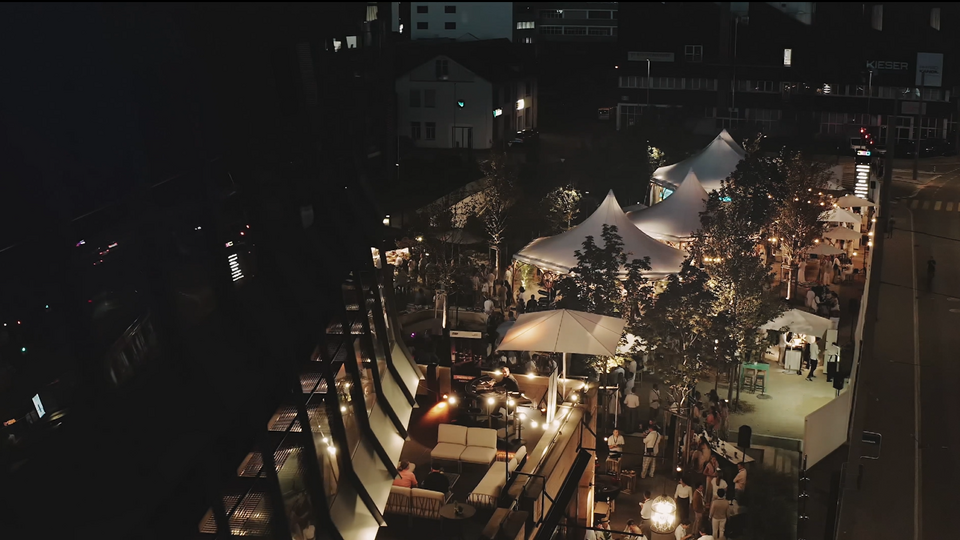
The closer indoor and outdoor areas are organized together, the less friction there is. It’s not just about square meters. What matters are short guest routes, sufficient capacity, appropriate technology, reliable catering processes, and the ability to maintain the event’s flow in both setups.
At JED Events, summer events can be held in the JED Park, in the outdoor area of Eve’s Kitchen, or on the Offset Terrace. A bad-weather plan is offered for summer events. Additionally, multifunctional indoor spaces, in-house catering, and a comprehensive technical infrastructure are available.
The advantage isn’t simply that the weather doesn’t matter. The advantage is that the alternative can be planned in coordination with the venue, catering, and technical team. This keeps responsibility centralized and ensures the transition is as seamless as possible for guests.
Ten Questions Before Approval
This short list summarizes the most important checkpoints. It is not a substitute for a site-specific safety assessment, but it helps ensure that nothing essential is overlooked.
| No. | Test Question |
|---|---|
| 1 | Which parts of the experience are weather-dependent? |
| 2 | Which official and local signals are being monitored? |
| 3 | Who makes the decisions, and who represents this person? |
| 4 | By when must each variant be triggered? |
| 5 | What permits and safety requirements might affect fire safety, structural elements, or usage? |
| 6 | Is the indoor version equivalent in terms of space and dramatic structure? |
| 7 | Will catering, technology, and guest routes work in both options? |
| 8 | Are water, shade, coat check, and accessible paths sufficient? |
| 9 | What text modules and contact lists are available? |
| 10 | Has the design variation been fully simulated across all trades? |
Conclusion: A robust plan feels effortless
For guests, an event should seem effortless. Behind this sense of ease lies a concept that can withstand changes. Weather resilience doesn’t come from a single sentence in the schedule. It comes from clear dependencies, equally viable alternatives, coordinated service providers, and a decision made at the right time.
Those who do this work early on reduce the need for frantic, ad hoc decisions and safeguard the experience. After all, in the end, guests rarely remember which option was internally referred to as “Plan B.” They remember whether they felt well-guided, safe, and welcome.
JED Events
Are you planning a summer party or a corporate event in Zurich?
At JED, our event venue in Zurich, we combine an outdoor atmosphere with flexible indoor spaces, in-house catering, and event technology—all from a single source. Together, we’ll develop a concept that delivers—even when conditions aren’t ideal. Let’s bring your idea and the right weather contingency plan early on.
Request an eventSources and Audit Trail
Source date: August 7, 2026. The links open in a new tab. Sources [1] and [2] were included because the events described took place on August 1 August and thus within the observation period, even though the announcements were published shortly before in some cases.
[1]Canton of Bern imposes fireworks ban involving drones and gas grills. SWI swissinfo, Keystone SDA, July 29, 2026.
[2]A fireworks display made entirely of water. Switzerland Tourism, event runs through August 1, 2026.
[3]Fire ban in and near forests. Canton of Bern, accessed on August 7, 2026.
[4]Transparency requirements under Article 50 of the AI Act. European Commission, updated on July 24, 2026.
[5]AI in Event Planning: What Takes Effect Starting in August 2026. JED Events, August 1, 2026.
[6]Bending Spoons agrees to buy Airtable. Axios, August 4, 2026.
[7]Eventbrite enters into an agreement to be acquired by Bending Spoons. Eventbrite / Business Wire, December 2, 2025.
[8]Open-Air Events and Festivals in Switzerland 2026. Watson, accessed August 7, 2026.
[9]Golf Trophy 2026. Swiss LiveCom Association / EXPO EVENT, August 5, 2026.
[10]JED Events Home Page. JED Events, accessed August 7, 2026.
[11]Summer Festivals in Zurich. JED Events, accessed August 7, 2026.
[12]Event Technology. JED Events, accessed August 7, 2026.
[13]Catering. JED Events, accessed August 7, 2026.


