How the Limmat Valley Is Gaining Momentum: Stephanie Kiener on Identity, Networking, and Events

Dear Stephanie, for anyone who isn’t yet familiar with Limmatstadt AG: What exactly do you do, and who’s behind the company?
Limmatstadt AG is the regional economic development agency for the Zurich and Aargau Limmat Valley. Our mission is to connect people, businesses, municipalities, and institutions and to initiate projects that strengthen the region in the long term.
We see ourselves as bridge-builders. Many good ideas already emerge within municipalities, businesses, or organizations. However, there is often a need for someone to bring the right stakeholders together, identify synergies, and support projects through to implementation. This is precisely the role we fulfill.
Limmatstadt AG is jointly supported by municipalities, companies, associations, and other partners. This broad support across cantonal borders is also one of our greatest strengths.
You know the Limmat Valley not only through your professional role but also from a personal perspective. What do you see in this region that is perhaps still often underestimated by outsiders?
Many people still reduce the Limmat Valley to its convenient location, highways, and through traffic. Yet they often overlook just how much dynamism, innovative power, and entrepreneurial spirit this region actually possesses.
I’m less impressed by what you see at first glance than by the attitude of the people. Behind the scenes, I meet people every day who want to actively help shape their region. This commitment and willingness to collaborate are what make the Limmat Valley special to me, and that’s exactly what’s often underestimated by outsiders.
You come from a background in location marketing, the event industry, and tourism. From your perspective, what is the difference between a region that is well-located and one that truly develops a distinct profile and appeal?
You can’t influence a good location. A distinct profile, on the other hand, arises from collaboration, attitude, and identity. A region develops appeal when it knows what it wants to stand for, when it highlights its strengths, and when people can actually experience them.
That’s exactly why encounters, networks, and joint projects are so important. They foster a sense of identification, and identification is ultimately much more sustainable than any image campaign.
If you had to describe Limmatstadt’s mission to our readers in one sentence: What is your specific added value for the region?
We bring people, ideas, and organizations together so that regional potential can be transformed into concrete projects with a sustainable impact for everyone involved.
In 2024, Limmatstadt reached a point where even its very existence was publicly called into question. What did this phase truly reveal?
Looking back, this phase was above all an opportunity. It forced us to take an honest look and ask what role Limmatstadt AG should actually play in the future. At the same time, it made it clear that regional economic development is successful when its mission is clear, its impact is transparent, and the stakeholders pursue a shared vision.
We used this phase to critically examine our role and sharpen our focus. In doing so, it became clear that regional business development does not need to take on as many tasks as possible. Rather, what matters most is taking on responsibility where collaboration creates real added value and where issues can be advanced more effectively together than acting alone.
This insight continues to shape our work to this day.
Today, we no longer see ourselves as an organization that does as much as possible on its own, but rather as a platform that brings people, ideas, and organizations together and focuses on those issues where we can have the greatest impact for the Limmat Valley.
Looking back, was this primarily a funding problem, a relevance problem, or a sign that regional economic development initiatives too often fail to explain their value in concrete terms?
I believe it wasn’t any one of these issues in isolation; rather, they were closely intertwined.
An organization can only be successfully funded in the long term if its value to stakeholders is clearly recognizable. And that was precisely the crucial point. Limmatstadt AG has done a great deal in the past, but it wasn’t always sufficiently clear what it was actually supposed to stand for and what concrete added value it creates for the region.
That’s why we didn’t just talk about funding; instead, we first re-examined our mission. Through dialogue with municipalities, the business community, and other partners, we defined where regional economic development can actually make a difference—namely, in areas where issues transcend municipal and cantonal boundaries and can only be resolved through collaboration. Only with this sharpened profile could the discussion about financing be placed on a new footing.
You took over operational leadership during a phase when many things needed to be reorganized. What was your initial focus: stabilizing, refining, or rethinking?
Actually, all of them at once—but in the right order. First, it was about listening and building trust. Then, together with our stakeholders, we refined our role and developed a new strategy based on that. Today, we’re consciously focusing on projects where we, as a regional economic development agency, can create the greatest added value.
Today, Limmatstadt AG has been realigned. But what does that mean in concrete terms when it comes to financing: Is the organization now sustainably positioned, or is it, above all, better supported than before?
We are now significantly broader and more stable than we were two years ago. That was one of the most important goals of the realignment.
At the same time, it would be unrealistic to claim that regional economic development is ever “fully funded.” Our task is to continuously create added value and to make that value visible. This requires financial and human resources.
I am convinced that this is precisely where sustainability lies: When municipalities, companies, and partners recognize that concrete projects emerge from collaboration, their willingness to support these efforts in the long term also grows.
In your opinion, who should finance regional visibility: primarily the public sector, the private sector, or a sustainable collaboration between the two?
Clearly, both. A strong region benefits everyone: the population, the municipalities, and the business community. That is why the responsibility should also be shared. It is precisely this partnership-based financing that makes regional location promotion credible and independent.
When municipalities, partners, and companies invest, they expect results. How exactly do you measure the success of Limmatstadt today?
Of course, we monitor traditional metrics such as new members, projects, or partnerships. But these alone don’t say much about our impact.
For me, success begins where networking gives rise to joint action. When municipalities develop projects together, companies actively get involved, or we explore topics such as vocational training or innovation at the regional level, that’s when the true value of our work becomes apparent.
Regional economic development cannot therefore be measured solely in numbers, but above all by whether we initiate and implement developments that would hardly have come about without this collaboration.
The Limmat Valley has grown enormously in economic importance. Nevertheless, people’s emotional perception of it often falls short of its actual significance. Why is that?
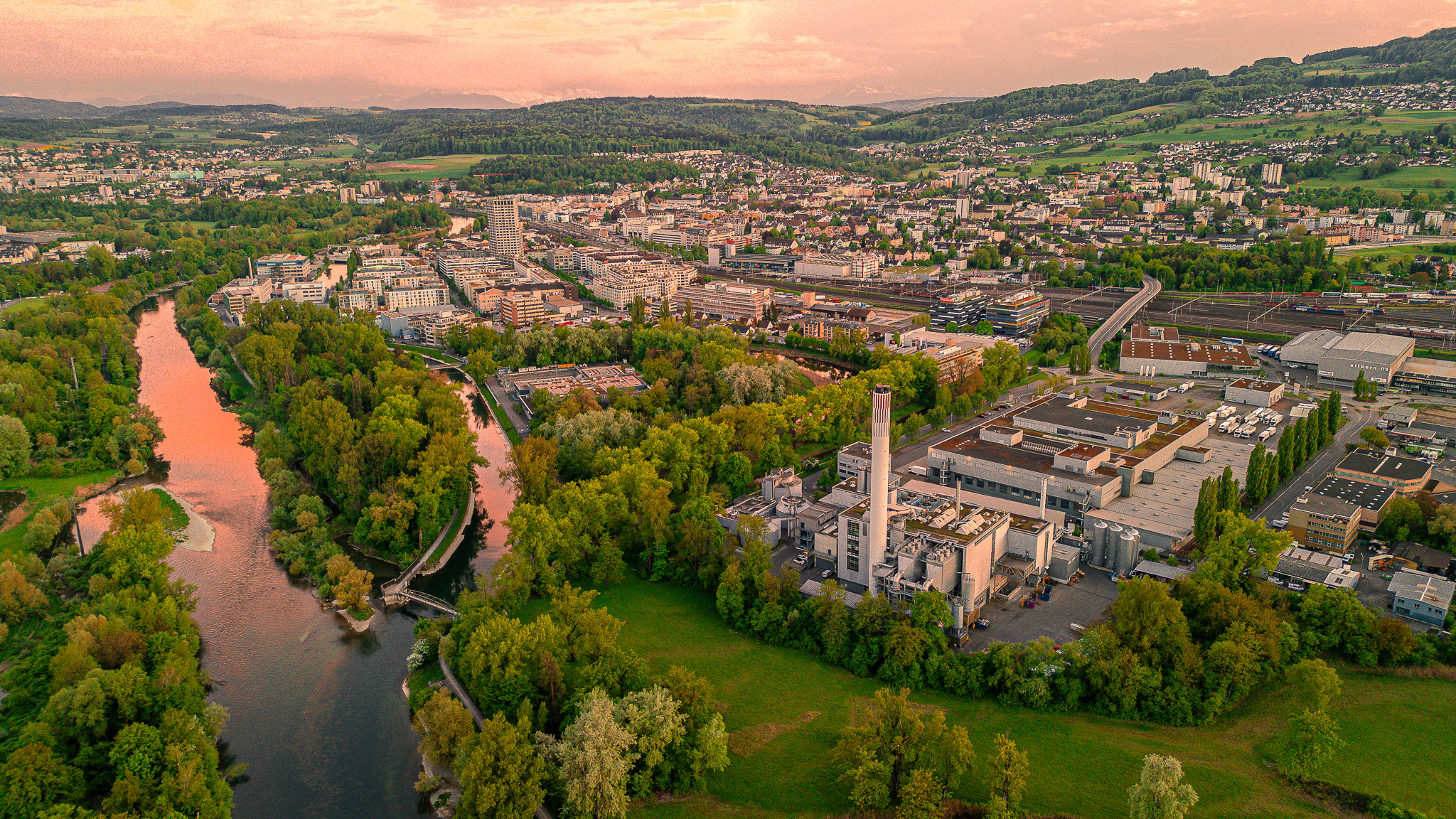
The Limmat Valley has developed tremendously in recent years—economically, in terms of infrastructure, and socially. Nevertheless, many people still view the region through the lens of outdated stereotypes: highways, industry, or through traffic. This image no longer reflects today’s reality.
At the same time, the Limmat Valley historically lacks something that many other regions have built up over the years: a shared regional identity. This is understandable. The Limmat Valley spans two cantons and many municipalities, each with its own history and identity. But this is precisely where a great opportunity lies.
Our goal is therefore not only to highlight the Limmat Valley’s economic strengths but also to raise awareness of our region’s qualities. We want to help ensure that residents, employees, and businesses identify with the Limmat Valley and develop a sense of pride in their region. After all, those who are proud of their region pass on its story, get involved in its development, and help ensure that the Limmat Valley is viewed positively by outsiders as well.
A region does not become strong simply by being economically successful. It becomes strong when people, businesses, communities, and organizations see themselves as part of a shared region and take responsibility for their common future. This is precisely what we at Limmatstadt AG aim to contribute to.
How can a region not only function effectively but also become a desirable destination—for businesses, talent, event organizers, and visitors?
A region becomes desirable when it doesn’t develop its strengths in isolation but rather presents them as a holistic experience. Today, companies no longer make decisions based solely on favorable conditions. They want to be part of an innovative ecosystem. Talented individuals value quality of life, networking opportunities, and room for growth. And event organizers seek locations with character, good infrastructure, and a supportive community.
This is precisely why collaboration among a wide variety of stakeholders is essential. Municipalities, businesses, cultural institutions, educational institutions, and event venues all contribute to a region’s appeal. It is crucial that these strengths do not exist in isolation but are perceived as a unified whole.
The role of regional location promotion is to connect these potentials and develop a coherent overall picture from them. After all, a region doesn’t become attractive because it offers everything, but because it credibly bundles its strengths and develops them together.
In your view, does the Limmat Valley still have an image problem, or is it more of a misalignment between reality and perception?
I would tend to call it a translation problem. The Limmat Valley doesn’t need to reinvent itself. The region already has an incredible amount to offer. The challenge lies rather in communicating this diversity clearly and as a cohesive whole to the outside world.
The Limmat Valley isn’t a single place with a landmark or a clearly defined identity. It’s a region with many strong communities, innovative companies, and dedicated stakeholders. This diversity is a major strength, but it also makes positioning the region more challenging.
That is precisely why we need an organization that connects these different stories and highlights their common thread. Only when many good individual stories come together to form a shared narrative will the region’s image to the outside world become clearer.
This is particularly exciting for our industry: In your view, what role do events play in a region’s visibility and positioning?
Events are far more than just individual gatherings; they are spaces for people to come together. They bring together people from business, politics, society, and culture, foster new connections, and bring a region to life. It is precisely in these settings that ideas, collaborations, and projects often emerge that go on to have a lasting impact.
For me, good events are therefore much more than just a pleasant evening. They foster encounters that spark ideas, nurture partnerships, and ultimately build a stronger region over the long term.
Can a strong event venue like JED Events do more to raise the profile of the Limmat Valley than some traditional image campaigns?
Absolutely. A venue like JED Events brings companies, professionals, and guests directly to the Limmat Valley. They experience the region firsthand, and that’s exactly what shapes perceptions far more sustainably than mere communication. Such venues become ambassadors for a region.
JED Events brings brands, companies, decision-makers, and guests to Schlieren. Where do you see concrete potential in closer collaboration between regional economic development agencies and private event venues like JED?
For example, I could envision events on regional topics of the future being deliberately held at the JED, companies from our network being brought together through innovative formats, or new platforms emerging where business, politics, academia, and startups can engage in dialogue. Such formats not only strengthen networking but also highlight what the Limmattal stands for.
Our role as a regional business development agency is not to organize every event ourselves. Our role is to bring the right partners together and create the right conditions so that, working together, we can develop initiatives that showcase the Limmattal as an innovative region while also creating real added value for everyone involved.
And finally, on a personal note:
Please complete the sentence: “For me, the Limmattal is …”
For me, the Limmattal is home—a place where people shape the future through diversity, drive, and collaboration.
Imagine you could organize an event with absolutely no budget constraints. What would it look like, what would it be about, and who would you invite?
I would organize a multi-day “Future Campus” for the entire Limmattal.
Companies, startups, schools, universities, municipalities, cultural organizations, political leaders, and the general public would work together on the future challenges facing our region, through lectures, workshops, innovation labs, exhibitions, and cultural events.
Not as a traditional conference, but as a place for connection and inspiration where new partnerships, visions for the future, and projects take shape.
Do you have a personal favorite spot in the Limmat Valley where you recharge and find inspiration?
I often go for walks with my dog along the Limmat River or in the forests of the Limmat Valley. That’s where I find peace and recharge my batteries. For me, it’s precisely in these places that the Limmat Valley’s diversity really shines through. It’s a region that uniquely combines economic dynamism with valuable local recreational spaces.
You might also be interested in


